Description
A vintage circuit in your DAW
Accurately modeled from the entire audio circuit of a vintage 1960s 176-style compressor: every tube, transformer, timing network, and power supply interaction is re-created using a real time circuit solver. This preserves the tone, timing, and dynamic behavior of the original hardware.
- Hardware-Accurate from Input to Output
The Relab 176 reproduces everything: the tone, timing, and dynamic behavior of the hardware. Every tube stage, transformer, and timing network responds as it does in the original. - Compression That Adapts to the Music
Fixed-threshold, variable-gain design where ratio, drive, and source material interact to shape timing, curve, and harmonics. - Instant Control Over Tone and Transients
Switchable interstage transformer, asymmetry detection, and calibration trims allow quick changes to character and transient handling.
Put the 176’s tone, timing, and control into your next mix – and hear it for yourself.
Classic sound, modern control
Ratio and knee behavior
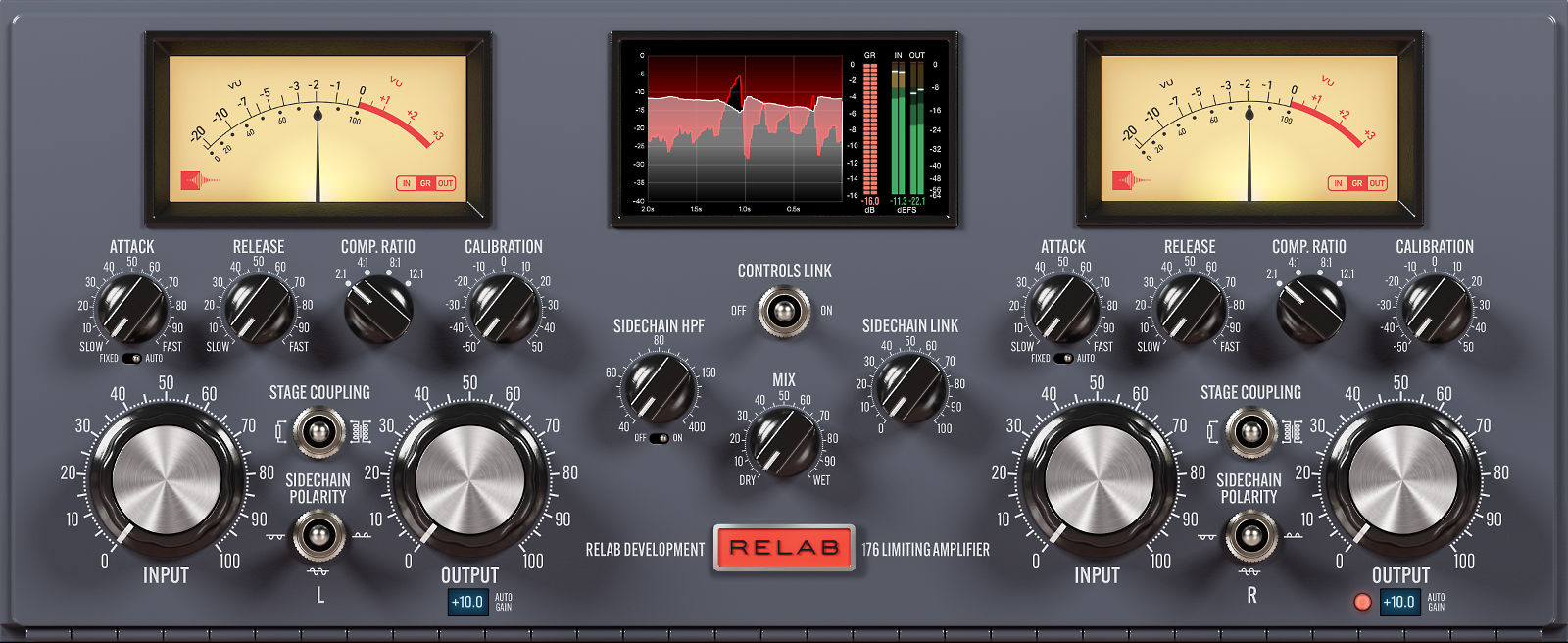
Choose from four hardware ratios: 2:1, 4:1, 8:1, and 12:1. Each changes the knee and slope, taking you from smooth leveling to assertive limiting.
Program-dependent timing
Attack and release emerge from resistor-capacitor networks interacting with the tube stage. Timing adapts to your signal; the Fixed/Auto toggle changes how release responds.
Polarity-selective detection
Choose whether the sidechain responds to the positive, negative, or both halves of the waveform. Shape transient edges to control kick attack or vocal plosives.
Choose the circuit path
Switch between two authentic circuit paths: Transformer for faster attack and added character, or Resistor for slower attack, flatter tone, and vintage low-end thump.
Bias, harmonics, and threshold
Calibration moves tube bias and balance together to shape threshold, harmonics, and dynamic feel. Use the back-panel trims when you want finer control.
Fine-tune the circuit
Click the Relab logo to reveal three trim controls—6BC8 bias, 6BC8 anode balance, and 12AX7 bias—plus Reference Level. Fine-tune gain staging, harmonic balance, and transient response.