
Description
Everything you need to create the sound of your dreams
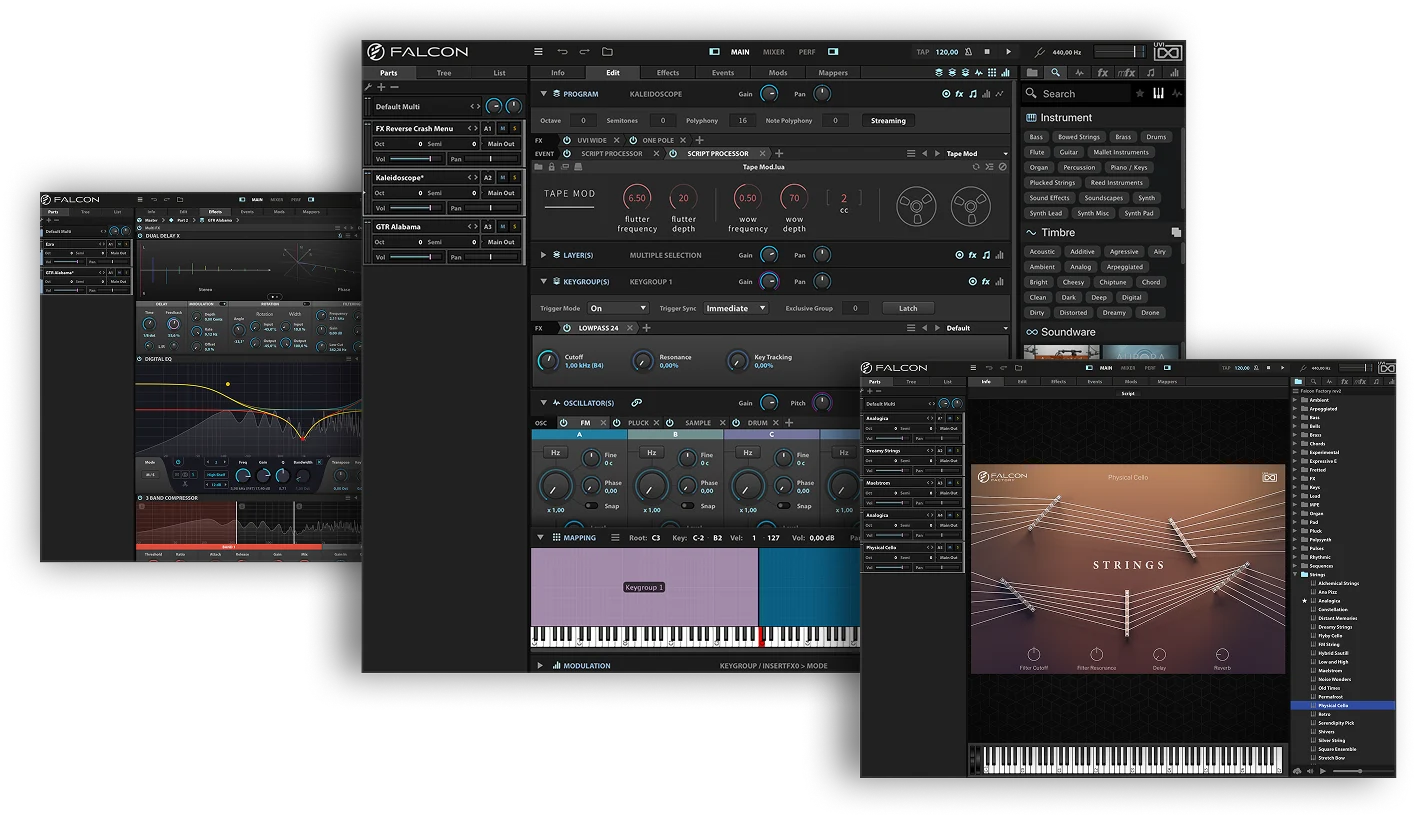
Falcon is more than an instrument, it’s your sound design universe. Built on a semi-modular
architecture of oscillators, effects, modulators, and event processors, it lets you create and shape
sound in any direction.
Whether you’re an experienced pro or just starting out, Falcon adapts to your workflow with a
streamlined browser, flexible workspaces, and thousands of inspiring presets.
Find the sounds you want
Falcon includes an expansive factory library of 1,700 presets and 500+ wavetables, crafted by
world-class sound designers to give you inspiring results right out of the box. Whether you’re
after instant gratification or a starting point for your own creations, Falcon puts inspiration at your
fingertips.
When you’re ready to explore further, Falcon Expansions and UVI Soundware open the door to
even more. Designed to take full advantage of Falcon’s advanced architecture, they integrate
seamlessly with the browser, making it effortless to search, tag, and find the sounds you need.
WHAT’S NEW IN VERSION 2027
Falcon 2027 delivers 4 new oscillators, from the vintage-inspired West Folder to our cutting-edge
Spectral Stretch, 10 new effects across delay, modulation, filters, eq, drive, dynamics, and analysis,
and a modulator that draws its shape from audio, all of it showcased across 100 new presets,
experienced through a newly refined interface with a richer browser, and many, many other
improvements.
New Oscillators:
West Folder: build complete West Coast voices with a single oscillator, shaping folded tones
and responsive contours in one unified path. Shape the waveform with Symmetry, Timbre,
Order, and Round, apply FM or AM from the built-in modulator, then let the lowpass gate
contour both tone and level. Automatic or manual, with velocity sensitivity available in auto
mode.
FM Explorer: Traverse through shifting FM timbres with a macro-driven three-operator
engine. Define the relationship between operators with Shift, then morph continuously
between series and parallel arrangements. Tune the result with Depth, Warp, Feedback,
Shape, Balance, and Ring Mod. A compact control surface keeps topology changes playable,
making complex motion easy to shape by ear.
Spectral Stretch: Separate pitch from time and reshape long recordings with this
phase-vocoder-based oscillator, streaming directly from disk. Phase modes move resynthesis
from loose and airy to fully coherent, with transient preservation adding extra punch on top,
giving sustained sounds, percussive material, and evolving textures a spectrum of characters.
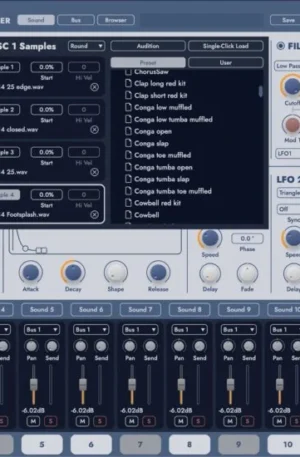
MultiSample: Build expressive multisampled instruments by mapping zones across key and
velocity, rotating alternates with round robins, and morphing across velocity layers. Per-zone
crossfades smooth the transition across velocity fade, turning layered recordings into playable
instruments that respond continuously across the keyboard.
New Effects:
Lowpass Gate: Shape any signal the West Coast way, with tone and loudness closing
together. This vactrol-style lowpass gate darkens as it fades in lowpass and combined modes,
or shapes loudness alone in VCA mode, giving drums, plucks and chords the natural ring of a
struck object. Let the auto-gate open and close with each note, optionally scaled by velocity,
and a flat loop will begin to breathe with each hit.
Wavefolder: Fold any signal back on itself. Where a clipper flattens peaks, a wavefolder turns
them over, adding harmonics that move with the input level. Timbre sets how deep the fold
goes, and Symmetry skews its shape. Give a sample, drum bus, or a whole layer the metallic
edge of West Coast synthesis.
FET Compressor: Grab transients with the fast attack of a FET compressor. Choose a fixed
ratio from the buttons, or change it continuously, then set Attack and Release against a VU
meter. Drive adds color and Mix brings parallel punch, for drums and vocals that sit up front.
Feedforward Compressor: Compress up or down from one feedforward design. The
detector reads the input, so gain changes are exact and repeatable. Run low and high level
segments, each with its own Threshold, Ratio, and a Knee that sweeps from hard to soft, or
switch the low level segment to Expand. Explore creative use by playing with the thresholds,
or dial in Peak or RMS detection, Auto Makeup, and Mix to round out a capable tool for
vocals, buses, and masters.
Steiner Filter: Morph between filter responses rather than switching them. This multimode
design blends its modes continuously, with Symmetry and Range shaping its character.
Resonance and Gain bring the bite, and a screen shows the internal behaviour.
Passive EQ: Shape tone with a passive program equalizer, in the spirit of the legendary EQ
that defined mastering rooms from the ‘50s on. Boost and attenuate the same low band at
once for that classic low-end shape, step through Low Frequency and High Frequency points,
and set the high Boost from Sharp to Broad with Bandwidth. A Curve button shows the
response behind the vintage panel. Works great on buses, drums, and mixes.
Analog BBD Delay: Get the dark, softening repeats of a bucket-brigade delay, from slapback
to long tempo-synced echoes. Select the BBD size, let the compander breathe, and raise
Noise as a color of its own. A resonant filter, Drive, and Blend shape the tail. For dub throws
and pads that melt into the mix.
Analog BBD Chorus: Add the stereo shimmer of a bucket-brigade chorus, in the spirit of the
‘80s studio rack units. Left and right modulate in opposite phase, so the image spreads while
pitch stays steady. Set the clock rate and delay offset from gentle wash to slow swirl, and let
the compander, noise, and inverted cross-mix add period character. For keys and pads that fill
the field.
Spectrogram analyzer: Watch the spectrum move through time. A spectrogram scrolls
frequency content in real time, so a filter sweep, a formant shift, or a stray resonance show up
as a clear picture. Set FFT size to trade time against frequency detail, choose the window
type, and pick your favorite color map.
Loudness Meter: Read loudness the way streaming platforms and broadcasters measure it,
in LUFS. Drop the meter on a program, a layer, or the master output and see at once whether
a patch sits where it should, how one preset compares with the next, or how far a mix is from
a delivery target.

Reviews
There are no reviews yet.